
From Clinicals to Classroom
A Nurse in the Making- Category: Community Partnership
Turning Nursing Education Into Real-World Patient Care
For McNeese State University nursing student Kaye Wallace, stepping into Lake Charles Memorial Hospital for her first clinical experience was different from anything she had experienced in the classroom.
Simulation labs had given her an opportunity to learn and practice nursing skills, but clinical rotations gave those lessons new meaning. At Memorial, Kaye began applying what she had learned while caring for real patients, working alongside experienced nurses and discovering the kind of environment where she hopes to build her career.
"I absolutely love it," Kaye recalls of her first experience at Memorial. "That's the environment I want to be working in."
Learning Beyond the Simulation Lab
Clinical education is an essential part of preparing future nurses. Through the partnership between McNeese State University's College of Nursing and Health Professions and Lake Charles Memorial Health System, students like Kaye have opportunities to take knowledge from the classroom and apply it in a real healthcare environment.
At Memorial, Kaye says nurses have helped guide and encourage her as she gains experience. They teach her not only how to perform the responsibilities of a nurse, but also how to look at patients differently, communicate with them and help them heal.
That guidance has helped her build confidence as she makes the transition from practicing skills on a mannequin to caring for a person.
Finding Her Own Way to Care for Patients
Kaye's journey to becoming a nurse has also required her to challenge assumptions about what a nurse can look like.
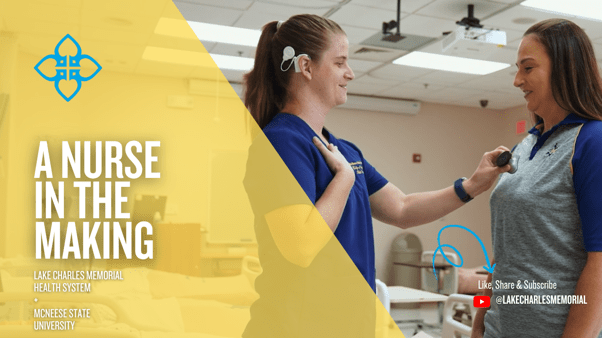
Kaye is deaf and uses a cochlear implant. When she entered nursing school, she knew she would have to navigate an educational and clinical environment largely designed for hearing students. With access to an interpreter and assistive technology, she has found ways to learn, communicate and provide patient care while becoming increasingly independent in the clinical setting.
One of those tools is a Bluetooth-enabled stethoscope that connects directly to her cochlear implant, allowing her to clearly hear a patient's heart and lungs.
Kaye is also intentional about communicating directly with patients whenever possible. Although her interpreter accompanies her to Memorial, Kaye says she often has her remain outside the patient room so she can develop the communication skills and independence she will need throughout her nursing career.
"I don't let my disability define me," Kaye says. "I just keep going."
Creating Opportunities for Future Nurses
Kaye's experience demonstrates what can happen when education, clinical opportunity, mentorship and determination come together.
Through clinical partnerships with healthcare organizations like Memorial, McNeese nursing students gain more than required clinical hours. They experience the realities of nursing, learn from professionals already caring for their community and begin discovering the kind of nurses they want to become.
For Kaye, that experience has reinforced her decision to pursue nursing—and given her an opportunity to show other students with disabilities that their goals don't have to be limited by what others believe is possible.
Her message to others is simple: pursue an education, find what you want to do and go for it.
The sky is the limit.